The AI Shift: Why You Need to Stop Memorizing Code and Start Framing Problems
Stop wasting hours memorizing code. Discover the Triangle Framework to empower your data team to leverage AI, focus on problem-solving, and accelerate results.

The "Hard Skills" Trap
Picture this: You are having a one-on-one with a bright, eager new analyst who just joined your team. They’ve looked at the tech stack, the complex financial models, and the data pipelines your team manages, and they are feeling the pressure. They sit across from you, notebook in hand, and ask the classic question: "Should I spend my evenings and weekends investing heavily in hard skills? Do I need to take deep-dive courses into Python, SQL, and DAX to succeed here?"
The old me — the manager from five years ago — would have nodded emphatically and handed them a list of 40-hour bootcamps. After all, I spent countless hours in the trenches wrestling with syntax, debugging Power Query errors, and learning Python the hard way. It was a badge of honor.
But my answer today was entirely different.
I told him: "Yes, you need to learn. But you should only focus on mastering the theoretical basics right now. Aim to be a '4 out of 10' in those hard skills. Understand the logic, and AI will do the rest."
Since generative AI became deeply integrated into our daily workflows, the ROI of rote memorization has plummeted. You can do much more, much faster — provided you have the right mental model. In my team of seven in FP&A Finance, we no longer optimize for syntax memorization; we optimize for problem framing.
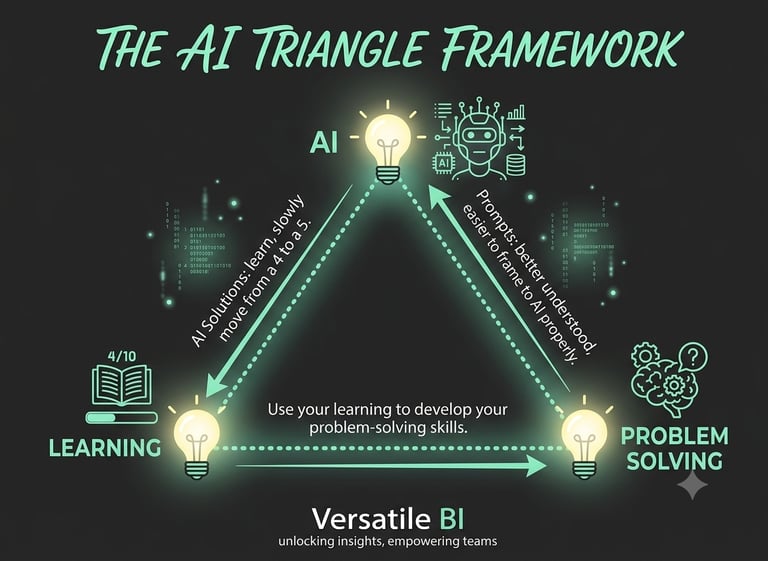
To make this actionable, I guide my team to apply what I call the Triangle Framework. It is a fundamental shift in how we work and study, and as managers, it is our responsibility to lead our teams through this transition.
The Triangle Framework: A Blueprint for the AI Era
If you want your team to be effective today, you have to redefine what "competence" looks like. The Triangle Framework maps out exactly how an analyst should allocate their cognitive energy.
Point 1: The Foundation of Learning (Bottom Left)
The bottom-left point of the triangle is dedicated to learning. I firmly believe that learning the basics of any hard skill is still non-negotiable. You cannot ask an AI to optimize a relational database if you don’t know what a primary key is. However, the depth of that learning has changed.
I tell my team: “Aim to be a 4 (out of 10) everywhere—whether it is Python, SQL, or DAX. The rest will come with time.”
You no longer need to invest heavily upfront to reach an 8 or a 9. You just need enough theoretical grounding to read the code, understand the architecture, and spot obvious hallucinations.
Point 2: Deep Problem Solving (Bottom Right)
The bottom-right point is dedicated to problem-solving. This is where human capital is most valuable. Before a single line of code is written or a dashboard wireframe is drawn, the business problem must be deeply understood.
If a stakeholder asks for a variance dashboard, a junior analyst might immediately start writing DAX. A problem-solver stops and asks: Why did this variance occur? What specific decision will this dashboard drive? What are the underlying data drivers? The better you understand the problem, the easier it becomes to frame it accurately to an AI.
Point 3: AI as the Execution Engine (Top)
The top point of the triangle is artificial intelligence. If you know enough theory (because you are a solid 4/10) and you completely understand the business problem, you can leverage AI to do the magic for you. Generative AI is the ultimate accelerator, taking your well-framed problem and translating it into flawless execution in seconds.
The Links: Putting the Triangle in Motion
The true power of this framework isn't in the points; it is in the connections between them.
From Learning to Problem Solving: You use your foundational 4/10 learning to understand what is technically possible. Knowing the basic constraints of Python or SQL allows you to design better, more realistic solutions to business problems.
From Problem Solving to AI: This is the art of prompt engineering. If you have done the hard work of breaking down the problem, your prompt to the AI will be incredibly precise. Instead of saying "Fix this code," you can say, "Write a SQL query that joins the actuals and budget tables, handling null values in the regional dimension, to highlight Q3 margin variances."
From AI back to Learning: This is the most beautiful part of the cycle. As you leverage AI to suggest solutions and write code, it acts as a personalized tutor. You read its output, you see how it solved the problem, and you learn. Slowly but surely, the AI pulls your hard skills from a 4 to a 5, and then to a 6, entirely in the flow of work. Recent analyses on the developer experience support this, noting that AI tools act like expert-level mentors, allowing junior staff to grow their expertise and confidence faster than traditional methods allow by providing real-time explanations and guidance (IBM, 2024).
The Manager’s Role: Engineering the Shift
You cannot just hand this framework to your team and expect them to change overnight. The world is changing rapidly, and as a manager, you need to actively guide your team through this disruption.
Research from McKinsey indicates that middle managers hold the absolute key to unlocking the potential of generative AI in the workplace. While AI frees up time, it is the manager who must guide the front line on how to prioritize that freed-up time and apply it to newly reshaped roles (McKinsey, 2024). Furthermore, AI actually increases the demand for effective management, as leaders are required to supervise the integration of these tools into workflows and ensure human judgment aligns with organizational goals (Giné, 2024).
Here are the concrete steps you must take to empower your team:
1. Institutionalize Time for Learning Your team will not grow if they are drowning in ad-hoc requests. As a manager, you must make room for learning on a recurring basis. Whether it is 15 minutes a day or an hour on Friday afternoons, protect their calendar. Give them the space to study the theoretical basics so they can reach that critical 4/10 baseline.
2. Demand Deep Thinking Upfront Encourage your employees to think deeply about the problem before they touch a keyboard. In 1:1s, stop asking, "How is the code coming along?" and start asking, "Walk me through how you framed this problem." Force them to articulate the "why" and the "what" before they outsource the "how" to an AI.
3. Foster a Culture of Leverage Celebrate the use of AI to develop further and faster. When an analyst uses the Triangle Framework to deliver a complex Python automation in a fraction of the usual time, amplify that win. Show the rest of the team that you value strategic leverage and problem-solving far more than brute-force hours spent debugging syntax.
The Before-to-After Shift
To fully empower our teams in this new era, we need to fundamentally shift how we value work.
The "Before" State: Before generative AI, an analyst's value was heavily tied to their syntax recall. You would spend countless hours searching forums to solve a single bug. You needed to possess deep, specialized knowledge (an 8 or 9 out of 10) just to get the problem solved. Time spent coding was the primary metric of effort.
The "After" State: Today, the paradigm has flipped. Your value lies in your ability to understand the business, frame the problem exceptionally well, and deploy AI to execute. You only need the foundational basics to start, because the actual act of solving the problem alongside AI becomes your real-time classroom.
Stop pushing your team to memorize code. Start teaching them how to think, how to frame, and how to leverage. When you do, you unlock an entirely new level of versatility and performance.
References & Resources
Mucci, T. (2024) AI isn’t just making it easier to code. it makes coding more fun | IBM. Available at: https://www.ibm.com/think/insights/ai-improving-developer-experience (Accessed: 05 July 2026).
Giné, M. (2024) Ai is increasing demand for managers — and changing their skill sets | Iese insight. Available at: https://www.iese.edu/insight/articles/artificial-intelligence-demand-human-skills/ (Accessed: 05 July 2026).
Field, E. et al. (2023) Middle Managers hold the key to unlock generative AI. Available at: https://www.mckinsey.com/capabilities/people-and-organizational-performance/our-insights/the-organization-blog/middle-managers-hold-the-key-to-unlock-generative-ai (Accessed: 05 July 2026).